


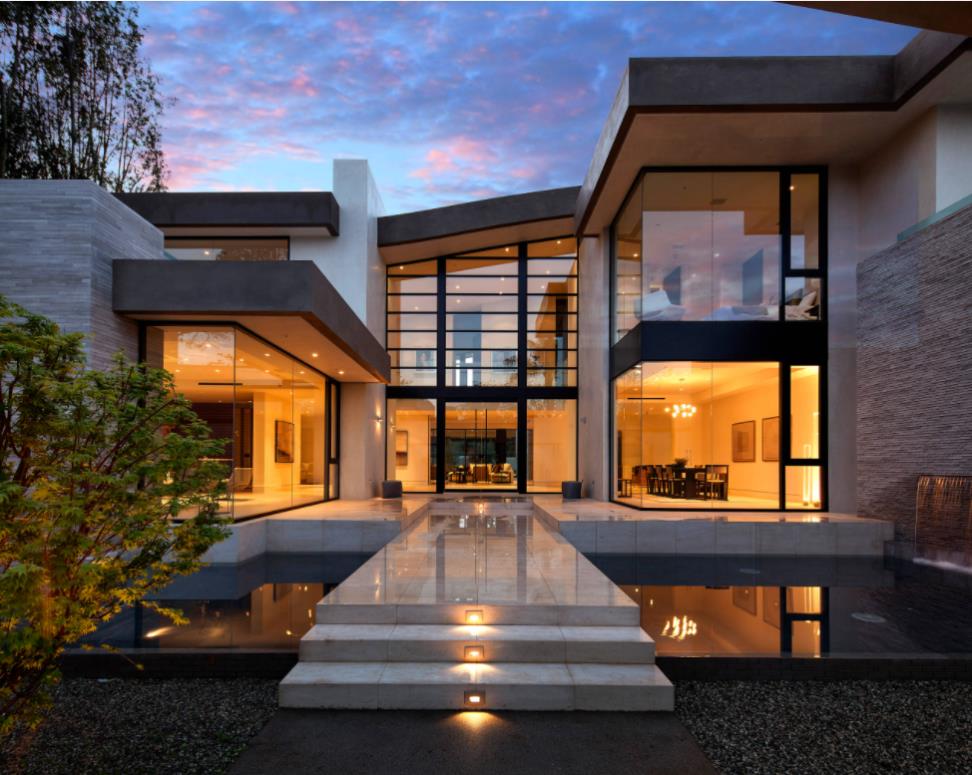
High performance energy saving glass emerged with the development of glass processing,glass coating technology,Materials technology.
- Glass coating:Lower and lower emissivity coated glass from single silver,double silver to now triple silver.
- Spacer materials:From traditional aluminium spacer,stainless spacer,warm edge spacer,composite warm edge spacer to TPS.
- Glass make up:From monolithic glass to insulated glass,triple glass units,and then vaccum glass.
More and more new creative products were developed,for example heat mirror insulated glass,aerogel glass, smart glass etc.
But high performance glass account less than 10% of new buildings,and existing buildings over 50 billion square meters adopt traditional normal glass or laminated glass,which caused high energy waste.High performance glass need further promotion and application on new constructed buildings.


Energy saving glass in passive houses
Table of Contents
What’s High Performance Glass?
High-performance energy-saving glass refers to architectural glass products that made with coating, insulating, and vacuum technology and have significant thermal insulation effects.
High Performance Glass Classifications.
The glass are mainly used in passive houses,mainly classified into below:Insulated glass,vacuum glass,vacuum insulated glass,heat mirror insulated glass.
- Key Performance Indicators of Glass:
Heat Transfer Coefficient (U-value): Measures the thermal insulation performance of the glass; a lower value is better. Passive houses require a U-value < 0.80 W/m²·K.
Visible Light Transmittance (T/VLT): Ensures sufficient natural light; a higher value is required, T > 55%.
Total Solar Transmittance (g-value): A lower total transmittance is better, controlling the amount of solar heat entering the room. Passive houses typically require g > 0.35 (to maximize daylighting in winter), but this should be optimized based on regional climate.
Infrared Thermal Transmittance (gIR): Controls infrared heat; gIR < 0.15.
Main Technical Features:
Multi-layer hollow structure: Typically uses three layers of glass (double-glazed), or even more layers.
Low-E coating: A very thin metal oxide film is coated on the glass surface to reflect infrared thermal radiation, achieving insulation or shading purposes.
Inert gas filling: The hollow layer is filled with inert gas (such as argon) to reduce air conduction and improve thermal insulation performance.
Thermal insulation spacers: Warm edge spacers (such as stainless steel or plastic composite materials) are used around the hollow glass to reduce the cold bridge effect.
High Performance Glass thermal property
Below table shows the insulated glass U value,light property and other thermal insulation performance.
| Glass Combination | Lowe Types | U value(w/m2.k) | SC | SHGC | LT % |
|---|---|---|---|---|---|
| Triple Glass Unit 6LE+12AR+6+12AR+6LE | Single +Single | 0.82 | 0.54 | 0.47 | 69 |
| Triple Glass Unit 6LE+16AR+6+16AR+6LE | Double+double | 0.78 | 0.29 | 0.33 | 51 |
| Quadruple Glass Unit 6LE+12AR+6LE+12AR+6+12AR+6 | Double +double | 0.69 | 0.31 | 0.27 | 46 |
| Vacuum IGU 6+12AR+6LE+V+6 | Double | 0.35 | 0.35 | 0.30 | 60 |
| Vacuum Glass 6+0.15v+6 | Double | 0.45 | 0.43 | 0.37 | 70 |
Above data are calculated based on WINDOW7.3, 90% argon content,as Window will calculate the glass center U value, increased glass edge performance result from warm edge spacers cannot be calculated here,but please check our previous post:
Argon filled insulating glass VS warm edge spacer insulating glass
- For most conventional window types, choosing to fill theinsulating glass with argon gas and replacing the aluminum spacers with warm-edge spacers can reduce the entire window U value by about 0.1-0.2W/m2K”.
- For double glazed unitswith 12mm spacer, the influence argon is better than using warm edge. For the triple glazed units, whether it is 12mm or 15mm spacer,warm edge spacer has much better thermal insulation performance than argon filled glass units. Especially for the 15mm,the reduction of U value is almost twice that of argon filled units.
- After using the warm edge, thethermal insulation performance of whole window is more balanced, and there is no obvious weak parts in the window. While using argon filling ,the balance of thermal insulation performance of each part of the window has been further broken.
High Performance Glass surface temperature and Anti-condensation performance
High Performance Glass Acoustic Performance
High-performance glass plays an increasingly important role in improving acoustic comfort inside buildings, especially in today’s dense urban environments where noise pollution is a daily challenge. Traffic, construction, airports, railways, and even nearby commercial activities can significantly affect occupant well-being, productivity, and sleep quality if not properly controlled.
The acoustic performance of glass depends on its ability to reduce sound transmission from the exterior to the interior. High-performance acoustic glass achieves this through a combination of thickness variation, laminated structures, and optimized insulating glass configurations. Laminated glass, in particular, is highly effective because it incorporates a special acoustic interlayer between two sheets of glass. This interlayer dampens sound vibrations, converting sound energy into low-level heat and significantly reducing noise penetration.
Another key factor is asymmetric glass design. By using glass panes of different thicknesses within an insulating glass unit (IGU), high-performance glass disrupts sound wave resonance, which is especially effective against mid- and low-frequency noise such as traffic and aircraft sounds. When combined with gas-filled cavities and high-quality edge seals, these systems can achieve excellent sound reduction values (Rw or STC), often improving acoustic insulation by 5–10 dB or more compared to standard double glazing.
Improved acoustic performance directly enhances indoor comfort. Quieter interiors support better concentration in offices, improved learning environments in schools, and higher quality rest in residential buildings and hotels. At the same time, high-performance acoustic glass can be combined with thermal insulation, solar control, and safety features, delivering multiple benefits in a single façade solution.
Ultimately, high-performance glass is not just a transparent building material—it is a critical component in creating calm, comfortable, and high-quality indoor spaces in noisy modern cities.


passive house insulated glass windows
Working with over 50 China glass processing factories,Morn now is able to manufacture and supply all kinds of high performance energy saving glass,including double and triple silver low-E coatings,warm edge space,triple glass units,etc.We sincerely hope the rapid development of ultra-low-energy buildings worldwide, so that people can live in good houses that are both energy-efficient and comfortable, and enjoy the comfortable experience brought by high-performance glass.
Download this article here:High performance energy saving glass analysis